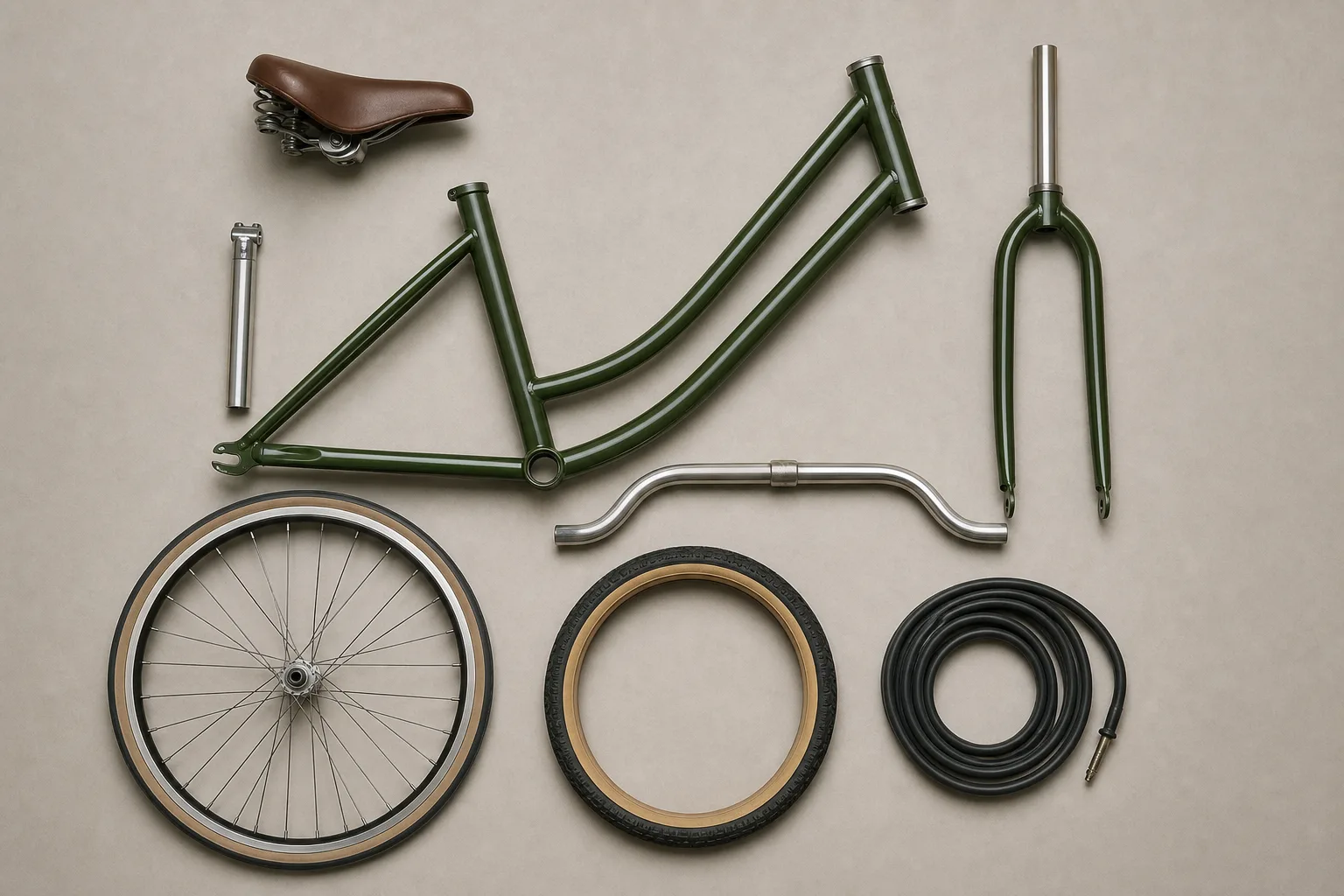
An account of working out which upright bicycles stay pleasant over short, frequent trips, based on riding a handful of them on the same errands and sending two back. Everything here is one rider's finding, not a recommendation.
The test stretch was half a mile of patched asphalt on a residential street, ridden at the same unhurried pace, on the same errands, at roughly the same time of day. Nothing scientific about it, but repetition does something that a single ride cannot: it separates the buzz that reaches the hands and the sit bones from the sharper hits that come from expansion joints and sunken utility covers. Those are two different problems, and the components sold to address them do not treat them equally. Sorting which does what took several months and two returns.
Tyre width and pressure did the most, by a wide margin
Moving from a 32 millimeter tyre to a 47 millimeter tyre on the same frame changed the character of the road more than any other single alteration tried. The buzz that had previously arrived as a continuous hum through the grips became intermittent, and the sunken drain covers stopped registering as impacts and started registering as events. Pressure mattered as much as width. The same wide tyre, inflated near its maximum, felt closer to the narrow one than to itself run soft. A careful reader checks the sidewall for the pressure range, not just the maximum, because most casing markings give both.
The practical finding was that the useful gains sat in the lower third of the printed range, and that they arrived without any weight penalty worth naming, since a wider tyre and tube typically adds a few hundred grams and nothing else. There is no bearing to service, no seal to replace, no bushing to develop play. Wider tyres do require clearance, and clearance is a frame decision made before purchase, which is why fender eyelets and stated maximum tyre width belong on the checklist rather than in the footnotes.
The suspension seatpost was the one moving part that earned its keep
A parallelogram-style suspension seatpost, set up with the right spring for rider weight, removed the specific vibration that arrives at the sit bones on an upright frame where a large share of body weight sits over the rear wheel. On the patched section it turned repeated small hits into a soft, slightly delayed motion that was easy to stop noticing. Two things qualified the result. It does nothing for the hands, and it adds a component with bushings, a spring, and a service interval that the seller usually states in hours or months rather than miles.
Setup determined almost everything. Undersprung, it bobbed under pedaling and felt vague. Oversprung, it behaved like a rigid post with extra weight. A careful reader checks whether the post ships with a spring matched to a weight range, whether replacement springs are sold separately, and whether the post is offered in the diameter the frame actually takes, since shims are common and not all of them are reassuring.
Sprung saddles and budget forks were the two returns
A sprung saddle with visible coils under the rear did soften single large hits, but on continuous rough asphalt it mostly moved the rider around rather than isolating them, and the springs allowed a side-to-side motion that made a straight line harder to hold at low speed. It went back. The undamped coil suspension fork went back sooner. On smooth pavement it dived under braking, on rough pavement it moved at a frequency unrelated to the road, and the buzz that reached the grips was largely unchanged because the fork's stiction kept it from responding to small inputs at all.
Both parts added weight where it is felt most on a bicycle lifted onto a rack or carried up steps, and both added a wear item. The fork in particular introduced bushings, a seal, and a stated service schedule for an assembly whose measured benefit on this route was not detectable. The Consumer Product Safety Commission is responsible for federal requirements applying to bicycles sold in the United States, and a fork that meets them is not thereby a fork that improves an errand bike.
What a careful reader checks before spending
The order that emerged is unglamorous and cheap. Confirm the frame's maximum tyre clearance with fenders installed, fit the widest tyre that fits comfortably, then find the lowest pressure that still resists pinch flats at rider weight. Ride it that way for two weeks. If vibration still reaches the sit bones, a suspension seatpost is the next spend, and it should be bought with its spring rate and service parts confirmed in advance. Grip and glove choices handle much of what remains at the hands, at almost no cost.
Everything above is one rider's finding on one road surface, and a different route with more curb ramps than patches would likely shuffle the middle of the list. The top of it seems stable. Air volume is the cheapest suspension available, it never needs a bushing, and it is the only one of these choices that a frame decision can quietly rule out before the bicycle is ever ridden.